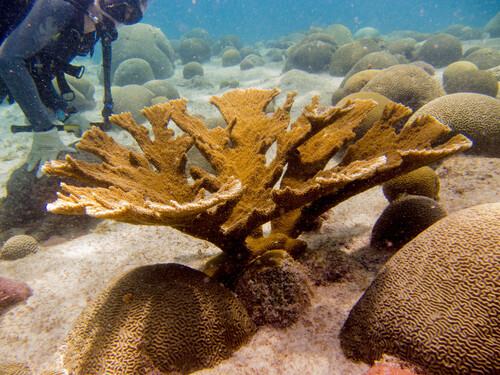
Coral cuerno de alceElkhorn coral
Elkhorn coralCoral cuerno de alce
Acropora palmata (Lamarck, 1816)
Acroporidae
Cómo reconocerloHow to recognise it
Ramas gruesas y aplanadas como astas de alce; marrón amarillento con puntas más claras.
Thick, flattened branches like elk antlers; yellowish brown with paler tips.
Cómo viveHow it lives
Antes dominante en crestas someras del Caribe; diezmado por enfermedad y blanqueamiento.
Once dominant on shallow Caribbean reef crests; devastated by disease and bleaching.
En esta costaOn this coast
Junto con el coral de fuego laminar, domina la cresta de Cahuita, donde rompen las olas, a solo 5–25 cm de profundidad.
Together with blade fire coral it dominates Cahuita’s crest, where the waves break, just 5–25 cm deep.
FichaData sheet
- Tamaño máximoMaximum size
- 4 m (tamaño de colonia)4 m (colony size)
- AlimentaciónDiet
- Fotosintético (zooxantelas o algas)Photosynthetic (zooxanthellae or algae)
- ActividadActivity
- De día y de nocheDay and night
- Dónde viveHabitat
- Cresta arrecifalReef crest
- En esta costaOn this coast
- FrecuenteFrequent
- Estado globalGlobal status
- EN En peligroEndangered (Lista Roja UICN)(IUCN Red List)
Registros en esta costaRecords on this coast
observaciones verificadas en iNaturalist entre Cahuita y Punta Mona. Puesto 16 de 315.
verified iNaturalist observations between Cahuita and Punta Mona. Rank 16 of 315.
Mide cuánto se fotografía, no cuántos hay: lo grande, colorido y somero se registra más.
This measures how often it is photographed, not how many there are: big, colourful, shallow things get recorded more.
Lo que dicen los estudios aquíWhat studies here say
Formaba la cresta de Cahuita. En 1983 el calor y la enfermedad de banda blanca mataron la mayoría de sus colonias. En 2019–2022 volvía a ser el coral principal en Isla Uvita, frente a Limón, con 39 % de cobertura.
It built the Cahuita crest. In 1983 heat and white-band disease killed most of its colonies. In 2019–2022 it was again the main reef builder at Isla Uvita, off Limón, with 39% cover.
FuentesSources: Quesada-Pérez et al. 2023
FuentesSources
- Cortés 1992. Los arrecifes coralinos del Refugio Nacional de Vida Silvestre Gandoca-Manzanillo, Limón, Costa Rica. Rev. Biol. Trop. 40(3). AbrirOpen
- Cortés & Risk 1984. El arrecife coralino del Parque Nacional Cahuita, Costa Rica. Rev. Biol. Trop. 32(1): 109–121.