Coral lechugaLettuce coral
Lettuce coralCoral lechuga
Agaricia agaricites (Linnaeus, 1758)
Agariciidae
Cómo reconocerloHow to recognise it
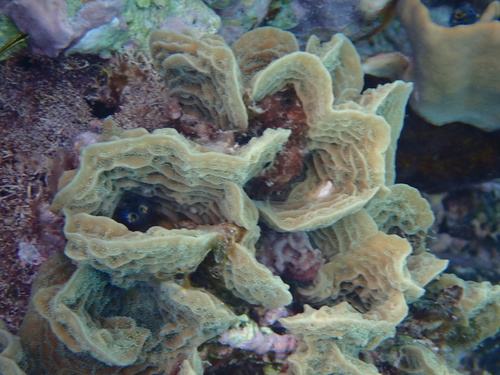
Placas delgadas y pliegues con crestas concéntricas, marrón a amarillo.
Thin plates and folds with concentric ridges, brown to yellow.
Cómo viveHow it lives
Formas variables según la profundidad y la luz.
Shape varies with depth and light.
En esta costaOn this coast
La especie de coral más abundante en Cahuita: ocupó el 55 % del coral vivo medido. Entre 3,5 y 5 m cubre hasta el 80 % del fondo y crece en láminas verticales.
The most abundant coral at Cahuita: 55 % of the live coral measured. Between 3.5 and 5 m it covers up to 80 % of the bottom, growing in vertical blades.
FichaData sheet
- Tamaño máximoMaximum size
- 1 m (tamaño de colonia)1 m (colony size)
- AlimentaciónDiet
- Fotosintético (zooxantelas o algas)Photosynthetic (zooxanthellae or algae)
- ActividadActivity
- De día y de nocheDay and night
- Dónde viveHabitat
- ArrecifeReef
- En esta costaOn this coast
- ComúnCommon
- Estado globalGlobal status
- VU VulnerableVulnerable (Lista Roja UICN)(IUCN Red List)
Registros en esta costaRecords on this coast
observaciones verificadas en iNaturalist entre Cahuita y Punta Mona. Puesto 106 de 315.
verified iNaturalist observations between Cahuita and Punta Mona. Rank 106 of 315.
Mide cuánto se fotografía, no cuántos hay: lo grande, colorido y somero se registra más.
This measures how often it is photographed, not how many there are: big, colourful, shallow things get recorded more.
FuentesSources
- Cortés 1992. Los arrecifes coralinos del Refugio Nacional de Vida Silvestre Gandoca-Manzanillo, Limón, Costa Rica. Rev. Biol. Trop. 40(3). AbrirOpen
- Cortés & Risk 1984. El arrecife coralino del Parque Nacional Cahuita, Costa Rica. Rev. Biol. Trop. 32(1): 109–121.
- Cortés et al. 2010. Monitoring coral reefs, seagrasses and mangroves in Costa Rica (CARICOMP). Rev. Biol. Trop. 58 (Supl. 3). AbrirOpen