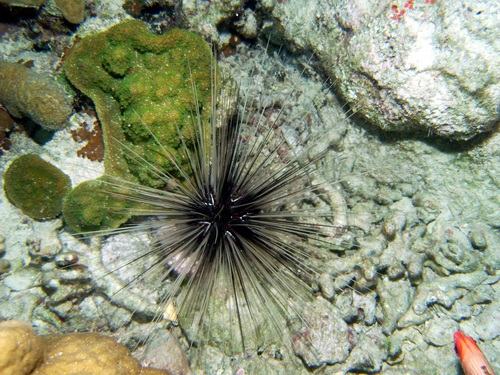
Erizo negro de espinas largasLong-spined sea urchin
Long-spined sea urchinErizo negro de espinas largas
Diadema antillarum (Philippi, 1845)
Diadematidae
Cómo reconocerloHow to recognise it
Caparazón negro con espinas muy largas y delgadas, negras (a veces bandeadas en juveniles).
Black test with very long, thin black spines (sometimes banded in juveniles).
OjoCareful: Las espinas se quiebran en la piel. Cuidado al pisar.Spines break off in skin. Watch your step.
Cómo viveHow it lives
Herbívoro clave del arrecife. Sufrió mortandades masivas en 1983 y 2022.
A key reef herbivore. Suffered mass die-offs in 1983 and 2022.
En esta costaOn this coast
Abundante en algunas zonas de Cahuita, sobre todo entre el coral dedo del frente del arrecife.
Abundant in parts of Cahuita, especially among the finger coral of the reef front.
FichaData sheet
- Tamaño máximoMaximum size
- 30 cm (largo de espinas)30 cm (spine length)
- AlimentaciónDiet
- HerbívoroHerbivore
- ActividadActivity
- De nocheBy night
- Dónde viveHabitat
- Arrecife, cascajoReef, rubble
- En esta costaOn this coast
- FrecuenteFrequent
Registros en esta costaRecords on this coast
observaciones verificadas en iNaturalist entre Cahuita y Punta Mona. Puesto 30 de 315.
verified iNaturalist observations between Cahuita and Punta Mona. Rank 30 of 315.
Mide cuánto se fotografía, no cuántos hay: lo grande, colorido y somero se registra más.
This measures how often it is photographed, not how many there are: big, colourful, shallow things get recorded more.
Lo que dicen los estudios aquíWhat studies here say
Antes de 1983 había de 3,6 a 8,8 por m² en Cahuita. La mortandad de 1983 los bajó casi a cero (0,001 por m² en 1992). En 2004 había 0,3–0,7 por m².
Before 1983 there were 3.6 to 8.8 per m² at Cahuita. The 1983 die-off took them to almost zero (0.001 per m² in 1992). By 2004 there were 0.3–0.7 per m².
FuentesSources: Cortés et al. 2010
FuentesSources
- Bolaños et al. 2005. Diversidad y abundancia de equinodermos en la laguna arrecifal del Parque Nacional Cahuita. Rev. Biol. Trop. 53 (Supl. 3). AbrirOpen
- Cortés & Risk 1984. El arrecife coralino del Parque Nacional Cahuita, Costa Rica. Rev. Biol. Trop. 32(1): 109–121.
- Cortés et al. 2010. Monitoring coral reefs, seagrasses and mangroves in Costa Rica (CARICOMP). Rev. Biol. Trop. 58 (Supl. 3). AbrirOpen